













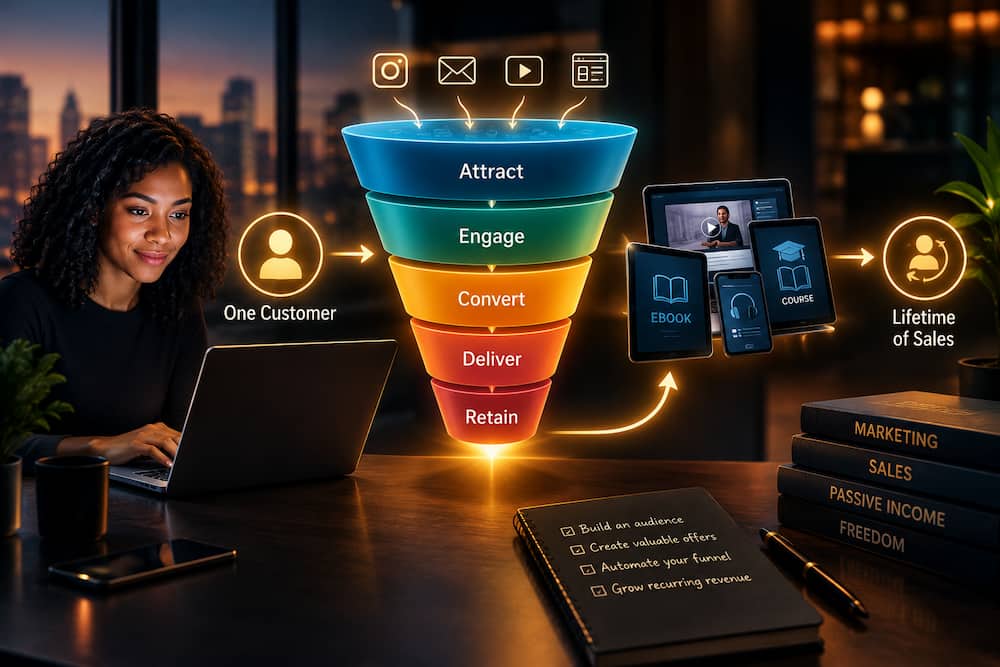
Selling a single digital product is one thing.
Building a business around a range of connected digital products is something else entirely.
You might have an ebook, an online course, a workbook, a template pack, a premium guide, a coaching programme or a collection of specialised resources.
Each product may be valuable on its own.
But there is a much more powerful question to ask:
What happens after someone buys the first product?
This is where the sales funnel becomes incredibly powerful.
Instead of treating every product as a separate sale, you can create a structured journey in which one product introduces the customer to the next.
The result can be a business where:
One customer → buys Product 1 → discovers Product 2 → buys Product 3 → upgrades to Product 4 → eventually becomes a high-value customer.
That is the fundamental power of a well-designed sales funnel.
What Is a Sales Funnel?
A sales funnel is a structured marketing and sales process that guides potential customers through a series of stages—from discovering your product to becoming a customer and, ideally, purchasing additional products.
It is called a “funnel” because you typically start with a large number of people at the top and progressively move a smaller percentage toward a purchase.
Think of it like this:
Attention → Interest → Trust → First Purchase → Additional Purchase → Customer Loyalty
Not everyone who discovers your business will buy.
And that’s normal.
The purpose of the funnel is to move the right people through the journey while giving them increasingly compelling reasons to continue.
Why Is a Funnel So Powerful for Digital Products?
Digital products have a unique advantage.
Unlike physical products, they can often be created once and sold repeatedly without manufacturing, packaging or shipping another physical item for every customer.
That makes digital products particularly well suited to funnel-based selling.
Imagine you sell products around a single subject.
You might have:
Product 1: £9 Beginner’s Guide
Product 2: £19 Workbook
Product 3: £39 Advanced Guide
Product 4: £79 Online Course
Product 5: £149 Premium Programme
You don’t necessarily need five completely separate marketing campaigns.
You can create a connected customer journey.
Someone who purchases the £9 guide has already demonstrated interest in your subject.
That person is potentially much more likely to be interested in your £19 workbook than a completely cold prospect who has never heard of you.
And someone who completes the workbook may be a stronger candidate for your £79 course.
The products become connected.
Each purchase can become the beginning of the next opportunity.
The Funnel Is About More Than Selling
A common misconception is that a sales funnel is simply a way of pushing people to buy.
A good funnel should do something much more sophisticated.
It should help the customer make progressively larger commitments as their confidence increases.
At the beginning, the customer knows very little about you.
They may not trust your expertise.
They may not understand your product.
They may not even know whether they have a problem that needs solving.
Trying to sell them your most expensive product immediately may therefore be difficult.
Instead, the funnel allows you to build the relationship progressively.
Stage 1: Get Attention
The customer discovers you through:
- Google;
- social media;
- YouTube;
- Pinterest;
- advertising;
- podcasts;
- articles;
- referrals;
- email;
- online communities.
Stage 2: Create Interest
You provide useful information that demonstrates your expertise.
Stage 3: Build Trust
You show the potential customer that you understand their problem and can help solve it.
Stage 4: Make the First Sale
You offer an affordable product that represents a relatively easy decision.
Stage 5: Deliver Value
The customer uses the product and experiences the quality of your work.
Stage 6: Introduce the Next Product
Now you can offer something that naturally builds on what they have already purchased.
Stage 7: Increase Customer Value
Over time, the customer may purchase several products.
This is where the economics of a funnel become extremely interesting.
The Customer Journey
Imagine a customer arrives at your website because they read one of your articles.
They don’t know you.
They aren’t ready to spend £100.
But your article provides useful information.
At the end, you offer a free downloadable resource.
They enter their email address.
Now you have permission to continue the relationship.
You send them useful information.
Eventually, you introduce a £9 eBook.
They purchase it.
After they buy, they see an offer for a £19 workbook that complements the eBook.
They purchase that too.
After completing the workbook, they are introduced to a £49 course.
They purchase the course.
Later, you offer a £99 advanced programme.
The customer now knows you.
They have purchased from you several times.
They understand the quality of your products.
And every subsequent offer is relevant to their previous purchase.
This is a product ecosystem rather than a collection of unrelated products.
The Different Types of Sales Funnels
There isn’t one universal funnel.
Different businesses use different structures depending on the product, price and customer.
Here are some of the most useful funnel types for digital products.
1. The Lead Magnet Funnel
This is one of the simplest funnels.
The process looks like:
Free Content → Free Resource → Email List → Paid Product
You offer something valuable for free in exchange for an email address.
Examples include:
- a checklist;
- eBook;
- template;
- mini-course;
- report;
- worksheet;
- guide.
The objective isn’t necessarily to make money immediately.
It is to turn an anonymous visitor into a known prospect.
2. The Low-Ticket Funnel
This funnel introduces the customer to an inexpensive product.
For example:
Free Content → £7 Ebook → £19 Workbook → £49 Course
The inexpensive product reduces the psychological barrier to making the first purchase.
Once someone becomes a customer, you have an entirely different relationship with them.
They are no longer merely a visitor.
They are a buyer.
3. The Tripwire Funnel
A tripwire is an inexpensive offer designed to convert a prospect into a customer.
For example:
Free Guide → £7 Special Offer → £29 Product → £79 Course
The initial purchase may not generate significant profit.
Its purpose can be to establish the customer relationship and introduce them to your products.
Once someone has purchased once, subsequent offers can become much easier to present.
4. The Webinar or Masterclass Funnel
This is particularly useful for more expensive products.
The customer might move through:
Free Content → Free Webinar/Masterclass → Core Offer → Premium Product
The educational presentation gives you an opportunity to demonstrate expertise, explain the problem and show why your solution is valuable.
This can work particularly well for courses, programmes and professional education.
5. The Product Launch Funnel
Instead of selling continuously, you build anticipation around a new product.
The process might be:
Content → Waitlist → Educational Content → Launch → Product → Upsell
This can create urgency and concentrated attention around a particular offer.
6. The Upsell Funnel
An upsell occurs when a customer is offered a higher-value product after making a purchase.
For example:
Customer buys:
£12 Ebook
Immediately afterwards:
“Take your results further with the Complete Course for £49.”
The offer is relevant because the customer has already demonstrated interest.
7. The Cross-Sell Funnel
A cross-sell recommends another product that complements the customer’s purchase.
For example:
Customer buys:
Social Media Guide
You recommend:
Social Media Content Template Pack
The second product isn’t necessarily more expensive.
It simply makes the first purchase more useful.
8. The Membership Funnel
A customer begins with a low-cost product and eventually enters a recurring membership.
For example:
Free Content → £9 Ebook → £29 Course → £15/month Membership
This can transform individual transactions into recurring revenue.
The Most Powerful Funnel for a Product Ecosystem
For someone selling multiple related digital products, one of the most powerful approaches is a value ladder.
A value ladder is a sequence of products that increases in value—and generally price—as the customer’s relationship with your business develops.
For example:
FREE
↓
Free article / video / checklist
↓
£9
Entry-level eBook
↓
£19
Workbook / templates
↓
£39
Advanced guide
↓
£79
Online course
↓
£149
Premium programme
↓
£299+
High-value service or coaching
The exact prices don’t matter.
The principle does.
Each product solves a bigger problem, provides greater value or delivers a deeper level of transformation.
The First Product Is Not Necessarily the Most Important Sale
This is one of the most important concepts in funnel marketing.
Suppose you sell a £10 ebook.
You make £10 from the first transaction.
But what if that customer eventually purchases:
£10 ebook
- £20 workbook
- £50 course
- £100 advanced programme
That customer has now generated £180 in revenue rather than £10.
This is why experienced digital-product businesses think beyond the first transaction.
They consider:
Customer Lifetime Value (LTV).
The question becomes:
“How much is an average customer worth to my business over the entire relationship?”
That changes how you think about marketing.
Your Products Should Lead Naturally Into One Another
This is where many digital-product businesses fail.
They create products independently.
Product A has nothing to do with Product B.
Product B has nothing to do with Product C.
The customer has no obvious reason to purchase another product.
A powerful product ecosystem works differently.
Each product should answer a logical question:
“What does the customer need next?”
For example:
Product 1
Learn the fundamentals.
Product 2
Put the fundamentals into practice.
Product 3
Solve more advanced problems.
Product 4
Master the subject.
Product 5
Achieve an advanced outcome faster.
Now you have a journey.
The Perfect Funnel Doesn’t Feel Like a Funnel
This is crucial.
A good funnel should not feel like:
“Buy this. Now buy this. Now buy this.”
It should feel like:
“You’ve completed this step. Here’s the logical next step.”
The difference is enormous.
Imagine someone purchases a beginner’s guide.
After they have had time to use it, you could say:
“Now that you’ve mastered the fundamentals, here’s a practical workbook that will help you put what you’ve learned into action.”
That’s not an arbitrary sales pitch.
It is a continuation of the customer’s journey.
Content Is the Fuel That Feeds the Funnel
Your funnel doesn’t begin with the checkout page.
It begins with attention.
That means content can become one of your most important marketing assets.
You might publish:
- blog articles;
- YouTube videos;
- social posts;
- newsletters;
- podcasts;
- tutorials;
- case studies;
- free guides.
The content attracts people who are interested in the subject.
Those people enter your funnel.
Some become leads.
Some become customers.
Some become repeat customers.
Your content therefore becomes the top of your sales machine.
Email Marketing Makes the Funnel Even More Powerful
Someone visits your website.
They leave.
You may never see them again.
Unless you have a way of maintaining the relationship.
This is why email marketing is so powerful.
A visitor who joins your email list can receive:
- educational content;
- useful tips;
- product recommendations;
- case studies;
- new product announcements;
- special offers;
- personalised follow-ups.
More importantly, email allows you to communicate with people after they leave your website.
Your funnel doesn’t end when someone closes their browser.
The relationship can continue.
Automation Turns the Funnel Into a System
This is where digital products become particularly attractive.
Much of the customer journey can be automated.
For example:
Visitor downloads free guide
↓
Automatically receives welcome email
↓
Receives educational email
↓
Receives product recommendation
↓
Purchases ebook
↓
Automatically receives purchase confirmation
↓
Receives onboarding email
↓
After several days, receives recommendation for complementary workbook
↓
After completing the sequence, receives offer for the next product
The system can operate continuously.
You don’t have to manually email every customer.
You build the system once and continually improve it.
The Post-Purchase Experience Is Critically Important
The funnel shouldn’t end at the checkout.
In many ways, the real relationship begins after the sale.
The customer should receive:
- immediate access;
- clear instructions;
- a welcome message;
- guidance on using the product;
- support where appropriate;
- recommendations for the next step.
A customer who has a great experience is far more valuable than someone who simply completes a transaction.
The objective is to turn:
Buyer → Satisfied Customer → Repeat Customer → Loyal Customer → Advocate
Don’t Sell Everything to Everyone
Another major mistake is presenting your entire product catalogue to every visitor.
Imagine arriving at a website and seeing:
17 ebooks
8 courses
12 workbooks
6 template packs
4 memberships
3 coaching programmes
The customer doesn’t know where to begin.
A funnel solves this problem.
Instead of asking:
“Which of my 50 products would you like?”
you ask:
“What is the next step this particular customer needs?”
That’s a much easier decision.
Personalisation Makes Funnels Even More Powerful
Different customers have different needs.
Someone who has purchased your beginner product should not necessarily receive the same marketing sequence as someone who has already purchased your advanced course.
You can segment customers based on:
- what they downloaded;
- what they purchased;
- what emails they interacted with;
- their interests;
- their stage in the customer journey.
This allows you to make offers more relevant.
And relevance is one of the most important principles of effective marketing.
The Mathematics of the Funnel
Consider a hypothetical example.
Suppose 10,000 people discover your content.
Perhaps 1,000 join your email list.
100 purchase your £10 entry-level product.
If 30 of those customers purchase a £30 product, that’s another £900.
If 10 purchase a £79 course, that’s another £790.
If 3 purchase a £199 premium product, that’s another £597.
Your funnel has generated:
£1,000 + £900 + £790 + £597 = £3,287
The precise numbers will vary enormously from business to business.
The important principle is that revenue doesn’t have to come from one product.
The funnel gives you multiple opportunities to create value and generate revenue from the same customer relationship.
The Goal Isn’t More Products
There is an important warning here.
Don’t create products simply because you think you need a bigger catalogue.
You don’t.
The goal is not:
“I need 20 digital products.”
The goal is:
“I need a logical progression that helps my customers achieve increasingly valuable outcomes.”
Five exceptional, connected products can be far more powerful than 30 unrelated products.
Build the Funnel Backwards
One of the smartest ways to create your funnel is to start with the highest-value transformation you want to provide.
Ask:
What is the ultimate result I want my customer to achieve?
Then work backwards.
What would they need immediately before that?
And before that?
And before that?
Eventually you arrive at the beginner’s problem.
This gives you a natural product ladder.
For example:
Ultimate Transformation
↓
Premium programme
↓
Advanced course
↓
Intermediate course
↓
Practical workbook
↓
Beginner guide
↓
Free educational content
Now every stage has a purpose.
A Complete Digital Product Funnel
Here’s what a sophisticated digital-product ecosystem might look like:
STEP 1 — ATTRACT
Blog articles, social media, YouTube, search engines and other content attract potential customers.
↓
STEP 2 — CAPTURE
Offer a valuable free resource in exchange for an email address.
↓
STEP 3 — NURTURE
Provide useful information that builds trust and demonstrates expertise.
↓
STEP 4 — CONVERT
Offer an affordable entry-level product.
↓
STEP 5 — DELIVER
Give the customer an excellent experience.
↓
STEP 6 — UPSELL
Introduce the next logical product.
↓
STEP 7 — CROSS-SELL
Recommend complementary products.
↓
STEP 8 — ASCEND
Introduce higher-value products as the customer’s needs become more sophisticated.
↓
STEP 9 — RETAIN
Use email and valuable content to maintain the relationship.
↓
STEP 10 — ADVOCACY
Satisfied customers recommend your products to others.
That is a complete customer journey.
A Sales Funnel Turns Products Into an Ecosystem
This is ultimately why sales funnels are so powerful for digital-product businesses.
Without a funnel, you have:
Products.
With a funnel, you have:
A system.
Without a funnel, you repeatedly search for new customers to buy individual products.
With a funnel, every customer has the potential to become a repeat customer.
Without a funnel, your products compete for attention.
With a funnel, your products can support one another.
And without a funnel, the end of a purchase is often the end of the relationship.
With a funnel, the purchase can become the beginning of the next stage.
The Ultimate Objective: Build a Customer Journey
The most powerful way to think about a sales funnel isn’t:
“How can I sell more products?”
It is:
“How can I help my customer move from where they are now to where they want to be?”
Once you understand that, your product strategy becomes much clearer.
You create the first product to solve the first problem.
Then you create the next product to solve the next problem.
Then the next.
And the next.
The customer doesn’t feel as though they are being pushed from product to product.
They feel as though they are progressing.
And that is the true power of a sales funnel.
One customer.
One problem solved.
One successful outcome.
Then the next.
Then the next.
A collection of digital products can generate individual sales.
But a carefully designed sales funnel can transform those products into a self-reinforcing business ecosystem—one capable of attracting prospects, converting customers, increasing customer value and building relationships that can last for years.
The objective isn’t simply to make the first sale.
It’s to create a customer journey where every successful step naturally opens the door to the next.