







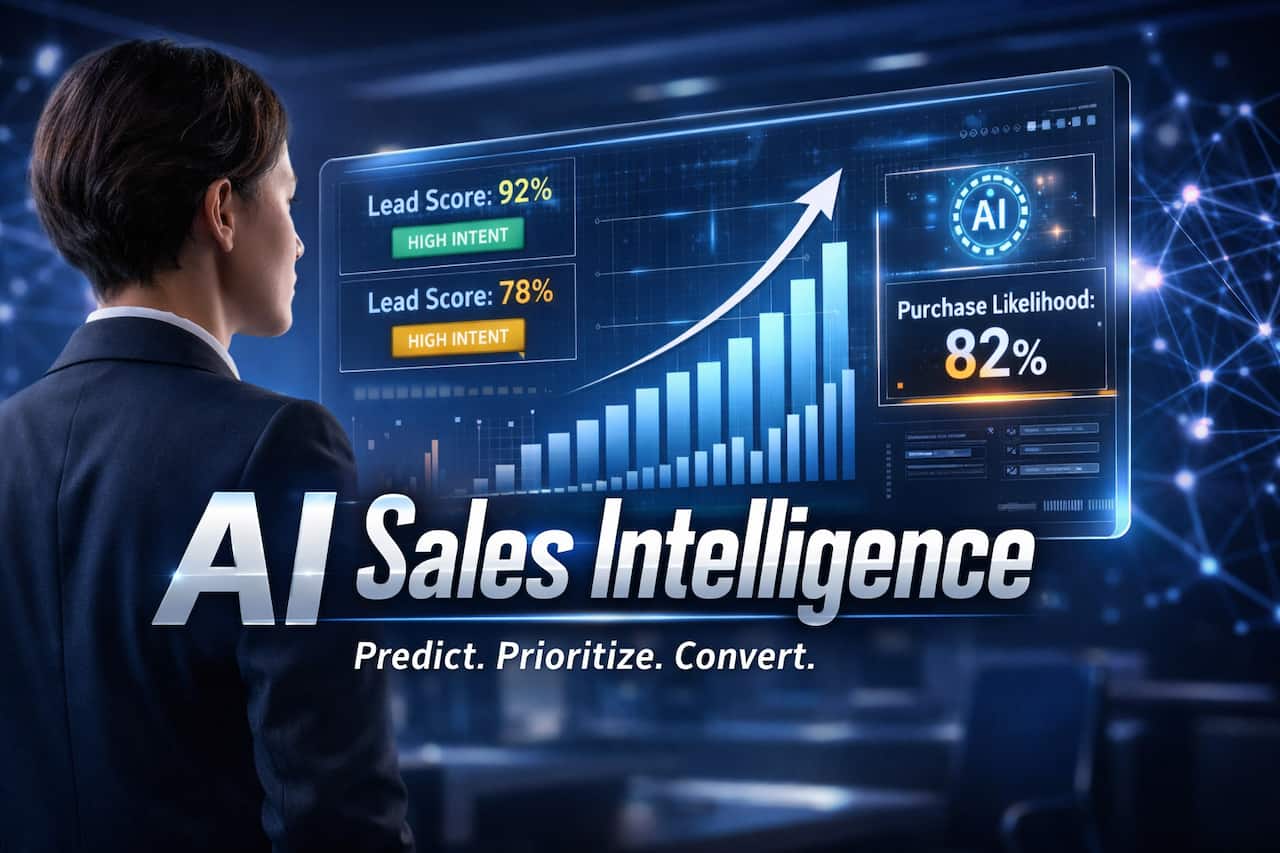
Sales intelligence used to mean “buy a list, call it, hope for the best.”
AI-powered sales intelligence is the modern upgrade: you use machine learning + real-time signals to identify who is most likely to buy, understand why, and engage them at the right moment—with messaging that feels personal even when it’s done at scale.
Instead of calling random lists, you build a system that:
- Ranks accounts and contacts by likelihood to convert
- Surfaces buying signals (funding, hiring, tech changes, website intent, engagement, champion activity)
- Predicts timing (who’s warming up vs. who’s months away)
- Automates research + personalization so reps spend time selling, not tab-hunting
That combination is why AI sales intelligence has become a genuine career advantage: it lets a rep produce higher pipeline quality with less wasted activity.
What “AI-Powered Sales Intelligence” Actually Is
AI-powered sales intelligence is the practice of using data + machine learning to:
- Discover and enrich prospects (accurate firmographics, technographics, contacts, org charts)
- Score and prioritize who to work next (propensity / fit / intent)
- Recommend actions (who to message, what to say, which objections are likely)
- Continuously learn from outcomes (replies, meetings, pipeline, wins/losses)
In plain English: it’s a decision engine for your sales day.
How It Works (The Engine Under the Hood)
Even if you never build a model yourself, knowing the mechanics helps you use these tools like a pro.
1) Data ingestion
The system pulls data from places like:
- CRM (HubSpot/Salesforce): historical deals, stages, notes
- Engagement: email opens/clicks/replies, meeting activity, LinkedIn touches
- Prospect data: company size, industry, tech stack, role seniority
- Behavior/intent: website visits, content consumption, job postings, funding, expansion signals
2) Data enrichment & normalization
This is where messy records become usable:
- Missing titles get filled
- Companies get standardized (one “Acme Inc.”, not five variants)
- Contacts are matched to accounts
- Signals are converted into clean fields (“hiring in RevOps = True”)
Clay is a popular platform here because it’s built to automate enrichment and research workflows in a spreadsheet-like interface and connect to multiple data sources.
3) Feature creation (turning “signals” into predictors)
Machine learning doesn’t “understand” your market—it finds patterns in inputs. Typical predictive features include:
- Fit: ICP match (industry, headcount, region, tech stack)
- Need: trigger events (new VP Sales hired, fundraising, tool migration)
- Ability: budget proxies (revenue band, growth rate)
- Intent: engagement level and recency
- Momentum: multi-threading, meeting frequency, stage velocity
4) Lead scoring & propensity models
A model outputs a probability score or rank-order list:
- “These 200 accounts look most like previous buyers”
- “These 40 are showing active intent right now”
Apollo, for example, positions its platform around automating research/scoring/outreach with embedded AI.
5) Timing prediction (“who is ready now?”)
The biggest productivity win is not just identifying good accounts—it’s identifying the moment they’re most likely to respond.
This is often driven by:
- Recency spikes (visited pricing page this week, opened 3 emails today)
- Event triggers (funding announcement, hiring spree, compliance deadline)
- Conversation cues (objection patterns, competitor mentions, timeline language)
6) Automated, personalized outreach at scale
Generative AI then turns structured intel into messaging:
- Role-specific value props
- Industry-relevant proof points
- Personalized openers based on a real trigger
- Follow-ups that reference the last interaction
Outreach highlights its Kaia-powered conversation intelligence as a way to capture transcripts/insights and help reps follow up more effectively.
7) Feedback loop (the part most teams ignore)
The system gets better when you feed it outcomes:
- Replies → what messaging works
- Meetings → what targeting is correct
- Stage conversion → where quality actually is
- Wins/losses → what predicts revenue, not just activity
Why This Skill Puts Reps Ahead of “Random List” Sales
Random list selling is high activity, low signal
When reps pull generic lists and hammer cold calls:
- Most prospects are wrong-fit
- Timing is arbitrary
- Messaging is generic
- Burnout rises (because effort ≠ results)
AI-powered sales intelligence is high signal, high leverage
You work:
- Fewer accounts
- With better fit
- At the right time
- With messages that match real needs
That’s how modern reps get “unfair” efficiency—often while doing less raw activity but producing more qualified pipeline.
Note on “80% more likely to buy”: Uplifts like this are possible in some orgs, but the honest number depends on your data quality, market, and whether you’re optimizing for revenue conversion (not vanity metrics like opens). The practical takeaway is the same: ranking + timing beats volume.
The Tool Stack to Master (and What Each One Is Best For)
Below is a modern, high-performing stack for AI sales intelligence workflows.
1) Clay — enrichment, signals, and “build your own prospect engine”
What you use it for
- Multi-source enrichment (contacts, companies, tech, triggers)
- Automated research at scale
- Building lead lists that update as signals change
- Feeding clean data into CRM and engagement tools
Clay is designed around automating enrichment/research workflows and reducing manual SDR busywork.
What to master
- Waterfall enrichment (best source wins, fallback sources after)
- Signal-based filtering (funding/hiring/tech changes)
- Clay tables as a “prospecting control panel”
- Routing enriched leads into HubSpot/Apollo/Outreach
2) Apollo — database + sequencing + AI assistance in one place
What you use it for
- Finding contacts/accounts
- Lead scoring and prioritization
- Sequences and outbound execution
- Reporting on outreach performance
Apollo markets “AI sales assistants” to automate research, scoring, and outreach.
What to master
- ICP filters that mirror your best customers
- Scoring rules (fit + intent + engagement)
- Sequence testing (messaging angles by persona)
- Pipeline attribution (which segments actually convert)
3) Outreach (with Kaia) — sales engagement + conversation intelligence
What you use it for
- Multi-touch sequences across email/calls/tasks
- Rep workflows and pipeline hygiene
- Conversation intelligence: transcription, insights, coaching support
Outreach describes Kaia as joining/recording meetings, transcribing, and surfacing in-the-moment insights to improve meetings and follow-ups.
What to master
- Trigger-based tasks (who gets a call today and why)
- Objection tagging from calls → updated messaging
- Coaching loops (what top reps do differently)
4) HubSpot AI (Breeze) — AI inside CRM, where your truth lives
What you use it for
- CRM-based insights (context-aware assistance)
- Meeting prep, summaries, content drafting
- Workflow automation using your CRM data
HubSpot’s Breeze positions AI tools as integrated across the Smart CRM, using your existing data for contextual assistance.
What to master
- Clean lifecycle stages + deal stages (so AI outputs aren’t garbage)
- Lead source + attribution fields
- Playbooks and snippets that AI can reuse consistently
- Dashboards that measure revenue outcomes, not activity
5) Gong — revenue intelligence, deal risk, and sales dashboards
What you use it for
- Capturing and analyzing sales conversations
- Deal health, risk signals, and forecasting support
- Performance dashboards and scorecards
- Improving rep behavior with real evidence (not opinion)
Gong positions conversation intelligence as a backbone for forecasting and deal risk assessment.
Gong’s help docs describe Dashboards (including pipeline generation and rep scorecards) as part of its analytics capability.
About “Gong Visual Q”
I couldn’t find an official Gong product feature publicly branded as “Visual Q.” Gong’s terminology tends to be Dashboards/Data Studio, Deal Boards, Forecast, and Deal likelihood/risk intelligence. If “Visual Q” is an internal nickname in your org, the closest public equivalent is Gong’s dashboarding + deal intelligence toolset.
How to Build a Sales Intelligence Dashboard That Actually Increases Conversion
Most dashboards fail because they track activity, not leverage. A high-conversion dashboard does three things:
1) It prioritizes who to work next
Core tiles:
- Top accounts by (Fit × Intent × Recency)
- “New triggers” list (funding, hiring, tech change)
- Hot leads with engagement spikes
2) It shows what to say and why
Core tiles:
- Persona pain points by segment
- Top objections from calls (from Gong/Kaia insights)
- Competitor mentions and win/loss reasons
3) It proves revenue impact
Core tiles:
- Conversion rate by score band (A/B/C leads)
- Meeting rate by segment + message angle
- Pipeline created per rep hour (the “efficiency metric”)
- Win rate by trigger type (e.g., “hiring signal” vs “generic ICP”)
Gong’s dashboards are explicitly designed to track pipeline generation and rep/team performance against targets, which makes it a strong layer for conversion-focused reporting.
The Skill Checklist: What to Learn So You’re “AI Sales Intelligent,” Not Just “Using Tools”
If you want this skill to compound your career, focus on mastery in this order:
- ICP engineering
Define what a real buyer looks like (not “anyone in SaaS”). - Signal design
Choose triggers that imply urgency (not vanity signals). - Scoring logic
Understand fit vs intent vs timing—and don’t mix them into one blurry number. - Personalization systems
Build reusable messaging frameworks powered by structured intel. - Feedback loops
Continuously update scoring and messaging based on conversion outcomes.
A Simple, High-Performance Workflow (Using Your Tool List)
Here’s a practical operating loop many modern teams run:
- Clay: build an ICP list → enrich → detect triggers → generate structured insights
- Apollo: source contacts + validate → score → run initial sequences
- Outreach: orchestrate multi-touch engagement + tasks + follow-up automation
- HubSpot AI: keep CRM clean, generate context-aware assets, automate routing and reporting
- Gong: analyze conversations, identify deal risk, improve messaging/coaching, and visualize conversion performance in dashboards