
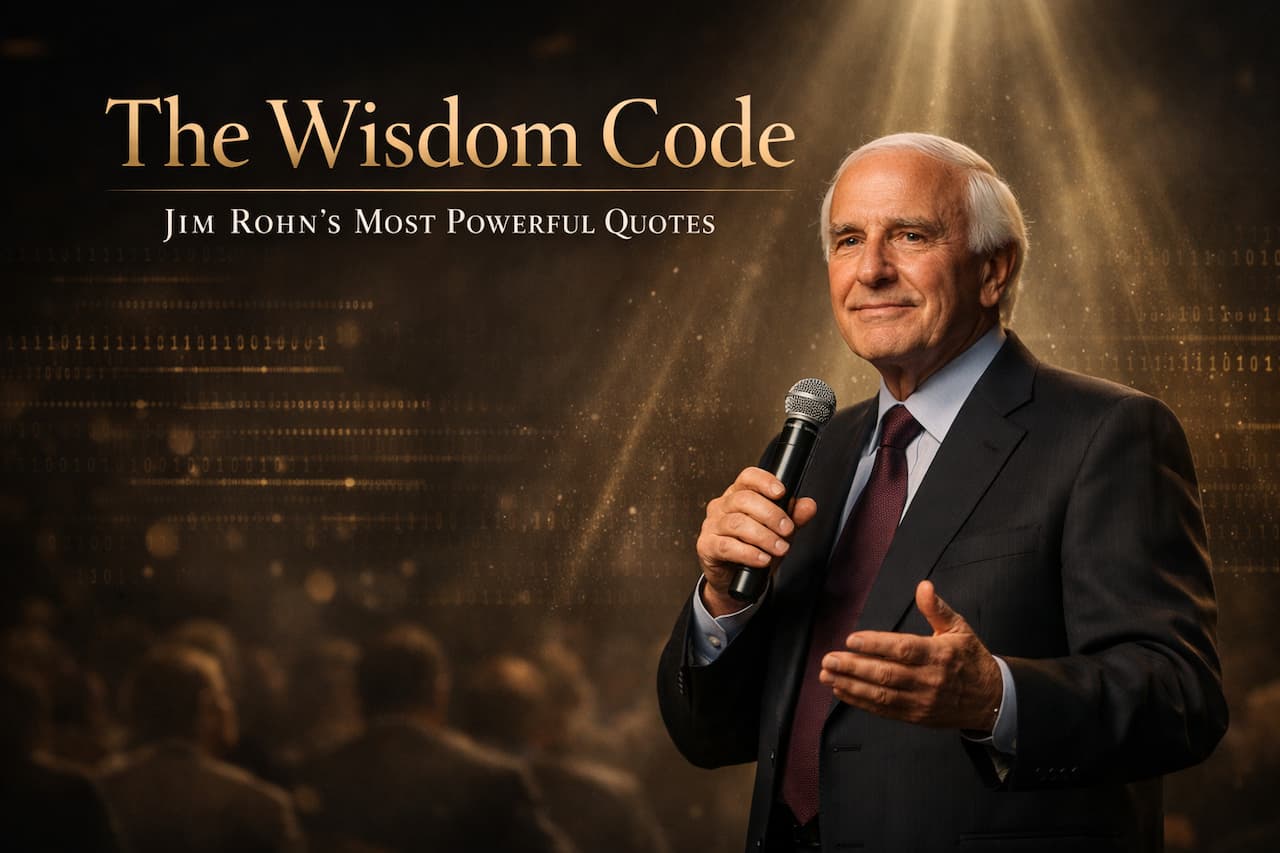
Jim Rohn was more than a speaker—he was a master architect of mindset and personal transformation. His words cut through complexity and get straight to the core of what shapes a meaningful, successful life: confidence, discipline, responsibility, growth, and purpose. In a world full of noise, his timeless wisdom stands as a clear and steady guide, reminding us that success is not found in luck or circumstance, but in the daily choices we make and the habits we build.
In this collection of Jim Rohn’s most powerful quotes, you’ll discover insights that challenge your thinking, sharpen your focus, and inspire you to take ownership of your life. These are not just quotes to read—they are principles to live by, each one carrying the potential to shift your mindset and elevate your future.
Motivation is what gets you started. Habit is what keeps you going.
This quote highlights the interplay between initial enthusiasm and sustained effort.
Breaking it down:
- Motivation: This refers to the initial spark or drive that pushes you to begin something, whether it’s starting a new project, adopting a healthy lifestyle, or learning a new skill. Motivation is often emotional or situational—something excites or inspires you in the moment.
- Habit: Once the excitement fades, it’s not motivation that sustains progress but discipline and habit. Habit refers to the routines or behaviors we do consistently, even when we don’t feel motivated. Over time, habits become automatic, making it easier to keep working toward your goals.
The key message:
Motivation is crucial to take that first step, but without developing consistent habits, motivation alone will not be enough to carry you through the inevitable challenges. Therefore, creating a routine ensures long-term progress and success, even on days when you’re not feeling particularly motivated.
Don’t join an easy crowd; you won’t grow. Go where the expectations and the demands to perform are high.
This quote emphasizes the importance of seeking out environments that challenge you in order to foster personal growth.
Breaking it down:
- Easy crowd: This refers to groups of people or situations where the level of challenge is low, and little effort is required to fit in or succeed. In these environments, you may feel comfortable or even complacent because there’s no pressure to improve or push your limits.
- Growth through challenge: On the other hand, Rohn encourages seeking out environments where the expectations are higher. Being in a group where people are striving for excellence or where there’s a greater demand for performance pushes you to rise to the occasion. The challenges you face will push you out of your comfort zone, ultimately helping you improve your skills, mindset, and overall potential.
The key message:
Comfort often leads to stagnation, while challenge leads to growth. Surrounding yourself with people who demand more of you will force you to develop and improve, leading to personal and professional growth. By pushing yourself to meet higher expectations, you become more resilient, knowledgeable, and capable of achieving greater things.
If you really want to do something, you’ll find a way. If you don’t, you’ll find an excuse.
This quoteunderscores the role of commitment and desire in achieving goals, and how excuses often serve as a mask for a lack of real intention.
Breaking it down:
- Finding a way: When someone truly desires to achieve something, they become resourceful, determined, and proactive. They seek solutions, overcome obstacles, and persist despite difficulties. This demonstrates the power of genuine commitment and creativity when working toward a goal.
- Finding an excuse: On the other hand, when someone lacks a strong desire to do something, they tend to rationalize their inaction or failure by creating excuses. Excuses often come from fear, procrastination, or a lack of genuine interest in achieving the goal. These excuses serve as a way to justify not taking action.
The key message:
This quote is about the difference between true desire and superficial intent. If you genuinely want something, you’ll prioritize it and overcome any challenges to achieve it. But if your desire is weak, you’ll focus more on reasons why you can’t or shouldn’t proceed.
It’s a reminder that action speaks louder than words, and true commitment is reflected in how you navigate obstacles, rather than how many excuses you make.
If you are not willing to risk the unusual, you will have to settle for the ordinary.
This quote highlights the relationship between taking risks and achieving extraordinary success or fulfillment in life.
Breaking it down:
- Risking the unusual: This refers to stepping outside of your comfort zone, trying new things, and taking risks that others might avoid. These risks could involve pursuing unconventional career paths, making bold decisions, or investing time and energy into something uncertain. Essentially, it’s about doing what most people won’t dare to do.
- Settling for the ordinary: On the other hand, if you avoid risks and stick to what feels safe or familiar, you may only achieve predictable and average outcomes. By not pushing your boundaries, you limit yourself to conventional success, or what is “ordinary.”
The key message:
Rohn is suggesting that achieving extraordinary results requires boldness and a willingness to take risks. Those who are too afraid to try something new or take a chance will likely lead a more predictable, “ordinary” life. To reach higher levels of success or fulfillment, you must be open to uncertainty and willing to embrace the unusual, even if it feels uncomfortable or risky at first.
A pessimist doesn’t see the sunset outside, he sees the dirt on the window.
This quote uses a metaphor to illustrate the difference in perception between a pessimist and someone with a more positive or open mindset.
Breaking it down:
- The sunset: Represents beauty, opportunities, and the positive aspects of life. A sunset is typically a symbol of something inspiring, peaceful, or uplifting.
- The dirt on the window: Represents the negative focus of a pessimist. Instead of appreciating the beauty of the sunset, a pessimist gets fixated on the imperfections (the dirt) that obstruct their view. The window symbolizes the lens through which they view life, but rather than focusing on what’s beyond, they dwell on the small flaws right in front of them.
The key message:
This quote suggests that a pessimist tends to focus on problems, obstacles, or imperfections instead of recognizing the positive aspects of a situation. Even when presented with something beautiful or promising, they fixate on what’s wrong.
The message is that perspective shapes our experience—if you’re always looking for flaws, you’ll miss out on the beauty and opportunities that are right in front of you. To lead a more fulfilling life, it’s important to shift focus away from the negative and appreciate the bigger, more positive picture.
We must all suffer one of two things: the pain of discipline or the pain of regret or disappointment.
This quote contrasts the discomfort of self-discipline with the long-term consequences of avoiding it.
Breaking it down:
- The pain of discipline: This refers to the temporary discomfort that comes with maintaining self-control, setting goals, and putting in consistent effort. Discipline often requires sacrifice, such as delaying gratification, sticking to a routine, and pushing yourself through challenges. While it may feel hard in the moment, this kind of pain leads to progress, achievement, and personal growth.
- The pain of regret or disappointment: On the other hand, if you avoid discipline, you may experience regret or disappointment later. This type of pain comes from missed opportunities, unachieved goals, or realizing you didn’t put in the necessary effort to reach your potential. It’s the lingering dissatisfaction that arises when you look back and wish you had done more.
The key message:
Rohn suggests that there’s no avoiding pain in life; it’s just a matter of choosing the type of pain you’ll experience. Discipline is hard but rewarding, while regret or disappointment is painful because it reflects what could have been. By embracing the short-term pain of discipline, you avoid the long-term pain of regret. It’s about making a choice now to put in the effort, rather than facing the disappointment of unfulfilled goals later.
Don’t wish it was easier wish you were better. Don’t wish for less problems, wish for more skills. Don’t wish for less challenge, wish for more wisdom.
This quote emphasizes personal growth and resilience as the keys to navigating life’s difficulties. It encourages focusing on self-improvement rather than hoping for easier circumstances.
Breaking it down:
- “Don’t wish it was easier, wish you were better”: Instead of wanting life’s challenges to be less difficult, focus on improving yourself. Becoming stronger, more capable, and more skilled makes it easier to overcome obstacles.
- “Don’t wish for less problems, wish for more skills”: Life is full of problems, and wishing for fewer of them won’t make them go away. The more productive approach is to develop skills and abilities that will help you solve those problems effectively. As you grow your skill set, problems become more manageable.
- “Don’t wish for less challenge, wish for more wisdom”: Challenges are inevitable, but instead of trying to avoid them, wish for the wisdom and insight to handle them better. Wisdom allows you to navigate complex situations with greater understanding, leading to better outcomes.
The key message:
This quote encourages self-empowerment through personal growth. Instead of seeking to make the external world easier or less challenging, it suggests that the real solution is to become better equipped to handle those difficulties. By focusing on improving yourself—whether it’s through skills, strength, or wisdom—you can face life’s challenges with greater confidence and competence. It’s a shift from wishing for an easier path to actively becoming the kind of person who can walk any path successfully.
Until we have finally accepted the fact that there is nothing we can do to change the past, our feelings of regret and remorse and bitterness will prevent us from designing a better future with the opportunity that is before us today.
This quote speaks to the importance of letting go of past mistakes and negative emotions in order to move forward and create a better future.
Breaking it down:
- Acceptance of the past: The first part of the quote emphasizes the need to come to terms with the fact that the past is unchangeable. No matter how much we dwell on mistakes or lost opportunities, the past cannot be altered. This acceptance is essential for emotional and mental peace.
- Feelings of regret, remorse, and bitterness: These emotions stem from a focus on the past—regret for things we didn’t do, remorse for actions we wish we hadn’t taken, and bitterness from unresolved pain. Holding onto these feelings can cloud our judgment and prevent us from seeing new opportunities in the present.
- Designing a better future: The second part of the quote highlights the power of living in the present and focusing on the opportunities that exist now. Once we let go of negative emotions tied to the past, we free ourselves to plan, take action, and create a future that is more aligned with our aspirations.
The key message:
Rohn’s message is that holding onto past regrets and negative emotions limits our ability to seize the opportunities available today. Only when we accept the past for what it is and release those negative feelings can we begin to design and build a better future. It’s about shifting focus from what you can’t control (the past) to what you can control (the present and future). Letting go of emotional baggage opens up space for growth, creativity, and success.
The more you know, the less you need to say.
This quote suggests that deep knowledge and understanding often lead to simplicity and quiet confidence, rather than the need for excessive explanation or discussion.
Breaking it down:
- “The more you know”: This refers to a deep, thorough understanding of a subject, situation, or concept. When you have a strong foundation of knowledge, you can see things more clearly, make better judgments, and grasp complexities without needing to prove or explain yourself constantly.
- “The less you need to say”: With real knowledge comes confidence. When you truly understand something, you don’t feel the need to over-explain or talk excessively to convince others of your point. You can communicate more effectively with fewer words, and often, silence or brief statements convey wisdom.
The key message:
Rohn is highlighting the contrast between superficial knowledge, which often leads to a lot of talking and explaining, and deep knowledge, which allows for brevity and clarity. People who know a lot tend to speak less because their understanding speaks for itself—they don’t need to prove it or impress others with words. In essence, the quote promotes the idea that true wisdom is shown through thoughtful communication and the ability to listen more than speak.
You cannot change your destination overnight, but you can change your direction overnight.
This quote emphasizes the importance of taking immediate action to shift your path toward a better future, even though reaching that ultimate goal takes time.
Breaking it down:
- “You cannot change your destination overnight”: This means that achieving significant goals or reaching a desired outcome (your “destination”) doesn’t happen instantly. Success, whether in personal growth, career, relationships, or any other area, takes time, consistent effort, and patience. You can’t achieve major changes or dreams overnight.
- “You can change your direction overnight”: While reaching a goal may take time, you can decide to change the course of your life instantly. Changing your “direction” refers to making immediate decisions or shifts in mindset, habits, or actions that set you on a new path toward the desired destination. It’s about taking that first step—committing to a new goal, plan, or behavior that will eventually lead to the long-term outcome you want.
The key message:
This quote encourages people to understand that major transformations don’t happen instantly, but you have the power to make immediate changes that will guide you toward those transformations. By changing your direction, whether through small steps or big decisions, you take control of your future and put yourself on the path to success. It’s a reminder that while the destination is far off, you can start making progress right away by shifting your focus and actions.
Formal education will make you a living; self-education will make you a fortune.
This quote highlights the difference between traditional education and the pursuit of knowledge through personal initiative and lifelong learning.
Breaking it down:
- “Formal education will make you a living”: This refers to the structured learning you receive in schools, colleges, and universities. While formal education can provide the necessary skills and qualifications to secure a job and earn a stable income, it often has limitations in terms of practical knowledge, critical thinking, and real-world applications. Formal education prepares you for a specific career path but may not equip you with the entrepreneurial or innovative skills needed for extraordinary success.
- “Self-education will make you a fortune”: In contrast, self-education involves taking the initiative to learn outside of traditional settings. This could include reading books, attending seminars, taking online courses, seeking mentors, or exploring areas of interest independently. Self-education empowers individuals to continuously adapt, develop new skills, and stay relevant in a rapidly changing world. It fosters creativity, critical thinking, and a deeper understanding of diverse topics, which can lead to greater opportunities and financial success.
The key message:
Rohn’s quote emphasizes the importance of taking control of your own learning. While formal education is valuable for securing a basic livelihood, it is through self-education that individuals can unlock their potential and achieve extraordinary success. This perspective encourages lifelong learning, curiosity, and the pursuit of knowledge beyond what is taught in classrooms, highlighting that self-driven education can lead to greater wealth and fulfillment in life.
Work hard at your job and you can make a living. Work hard on yourself and you can make a fortune.
This quote contrasts the effort put into one’s job with the importance of personal development and self-improvement.
Breaking it down:
- “Work hard at your job and you can make a living”: This part emphasizes that dedicating yourself to your job—fulfilling responsibilities, meeting deadlines, and performing tasks—can lead to earning a stable income. Many people find success by excelling in their roles and contributing to their organizations. However, this level of effort typically results in a limited ceiling on earnings, as it often reflects the structure and demands of the job rather than individual potential.
- “Work hard on yourself and you can make a fortune”: Here, Rohn suggests that investing in personal growth—developing skills, enhancing knowledge, improving mindset, and building character—can lead to significantly greater opportunities and rewards. By focusing on self-improvement, you increase your value, adaptability, and potential to seize new opportunities. This effort can lead to breakthroughs in your career, entrepreneurship, or other ventures, resulting in much higher financial rewards.
The key message:
Rohn’s quote encourages individuals to prioritize personal development as a means to achieve greater success. While hard work at a job is valuable, focusing on self-improvement opens doors to more opportunities and financial success.
This perspective promotes the idea that enhancing your abilities, mindset, and understanding of the world can lead to transformative outcomes, both professionally and personally. It’s a reminder that true wealth comes not just from what you do for a living but from who you become through ongoing learning and growth.
If you don’t change what you are doing today, all of your tomorrows will look like yesterday.
This quote emphasizes the importance of taking action and making changes in your current habits and behaviors to create a different future.
Breaking it down:
- “If you don’t change what you are doing today”: This part suggests that if you continue with the same routines, habits, and mindset without making any adjustments, you are likely to remain stagnant. It implies that complacency or resistance to change will prevent growth and improvement.
- “All of your tomorrows will look like yesterday”: This means that without change, your future will mirror your past. If you repeat the same actions and decisions, you will experience the same outcomes. The quote serves as a cautionary reminder that a lack of proactive effort can lead to a repetitive cycle where progress is stifled, and opportunities for growth are missed.
The key message:
Rohn’s quote encourages individuals to take responsibility for their present choices and to recognize the power of change. It underscores the idea that if you want to improve your circumstances, achieve new goals, or enhance your quality of life, you must be willing to make intentional changes today.
This perspective promotes the concept of personal growth as an active process, urging individuals to evaluate their current actions and be proactive in making adjustments that will lead to a better future. Without change, there is little chance for improvement; therefore, it is essential to embrace new actions and mindsets to create a different, more fulfilling tomorrow.
The major value in life is not what you get. The major value in life is what you become.
This quote highlights the distinction between material possessions or achievements and personal growth and development.
Breaking it down:
- “The major value in life is not what you get”: This part suggests that the tangible rewards we accumulate—such as money, possessions, or status—are not the most important aspects of life. While these things can provide comfort or pleasure, they are often temporary and do not define true success or fulfillment.
- “The major value in life is what you become”: Here, Rohn emphasizes that the true measure of success lies in personal development and the qualities we cultivate over time. This includes our character, skills, mindset, and the impact we have on others. Becoming a better person—through learning, experience, and self-reflection—adds depth and meaning to life.
The key message:
Rohn’s quote conveys that personal growth and the journey of self-improvement are what ultimately enrich our lives. It encourages individuals to focus on the process of becoming—developing their values, abilities, and relationships—rather than merely seeking external rewards.
This perspective fosters a sense of purpose, as it emphasizes that the experiences and lessons learned along the way contribute to a fulfilling and meaningful life. Ultimately, true fulfillment comes from who you become as you navigate your journey, rather than what you possess at any given moment.